
Why Every Business Needs a Modern Website in 2026
A modern website is no longer a brochure — it is your sales engine, trust layer, and growth system for 2026.
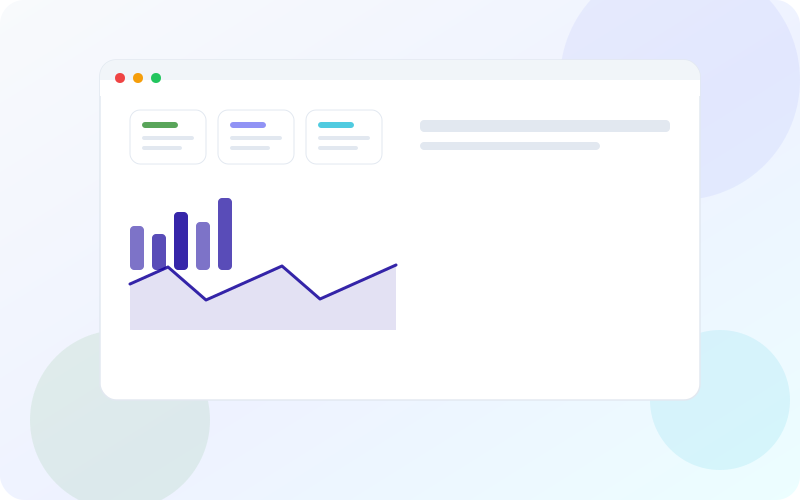
In 2026, a business website is not a digital brochure you update when someone remembers. It is the system that qualifies demand, carries brand proof, supports paid and organic acquisition, and keeps sales conversations from starting cold. Buyers research, compare, and shortlist long before they speak to a human. If your site cannot do that work with clarity and speed, you are forcing revenue to depend on luck, referrals, and expensive follow-up.
A modern website is a growth system: strategy, design, engineering, content, analytics, and conversion paths working as one product. This article explains why that system matters now, what breaks when teams treat the website as a one-time project, and how to build (or rebuild) with outcomes that leadership can measure. If you are evaluating delivery partners, start with our services overview or book a meeting to map priorities against your pipeline.
Why It Matters
The cost of a weak website is no longer limited to “looking outdated.” Weak sites leak paid media spend, underperform in search, confuse high-intent visitors, and force sales teams to re-explain what the company does. Strong sites do the opposite: they compress time-to-trust, route the right visitors to the right next step, and compound returns from every other channel you already fund.
Three structural shifts make this urgent in 2026:
- Buyer self-serve behavior is default. Decision-makers expect clear positioning, proof, pricing logic (or at least process clarity), and fast contact options without waiting for a call.
- Acquisition costs remain high. When clicks are expensive, conversion rate and message match become margin levers, not “nice UX.”
- AI-assisted discovery raises the bar. Summaries and answer engines reward sites that are structured, trustworthy, and useful—not thin template pages with interchangeable claims.
Typical window in which first-visit users decide whether a site feels credible enough to keep reading. Layout stability, hierarchy, and load speed are part of that judgment—not afterthoughts.
Treat the website as infrastructure for growth, and every campaign, sales hire, and content investment becomes more efficient. Treat it as decoration, and those same investments quietly underperform.
Your website should do the first sales meeting before the first sales meeting happens.
— Grove Web Digital
Current Industry Challenges
Most companies do not fail because they lack a website. They fail because the site was built for an earlier operating model and never upgraded to match today’s buyer journey.
Challenge 1: Brochure architecture in a product-led market
Many sites still organize around internal departments—“About,” “Services,” “Contact”—without mapping pages to intent. Visitors arrive with specific jobs: compare options, evaluate risk, understand delivery, or request a consult. If the architecture does not answer those jobs in order, bounce rates rise even when traffic quality is fine.
Challenge 2: Performance debt from plugins, tags, and design excess
Marketing stacks accumulate. Chat widgets, heatmaps, A/B tools, pixel managers, and heavy animation libraries all compete for main-thread time. The result is a site that looked fine in a staging demo and feels sluggish on mid-range mobile networks—the exact conditions many buyers use.
Challenge 3: Content without a conversion system
Publishing blog posts or service pages is not enough. Without internal linking, clear CTAs, proof placement, and CRM-ready forms, content becomes an expensive archive. Modern sites need content that feeds pipeline stages, not vanity traffic charts.
Challenge 4: Fragmented ownership
Design owns visuals, marketing owns copy, IT owns hosting, and nobody owns conversion outcomes. In 2026, high-performing teams assign a single accountable owner for the website as a product—with a backlog, metrics, and release cadence.
Challenge 5: Trust gaps that sales cannot paper over
Buyers look for case evidence, process transparency, security posture, and realistic timelines. Vague claims (“best,” “leading,” “innovative”) without proof create skepticism. Your portfolio and structured case narratives are not vanity assets; they are conversion infrastructure.
Detailed Explanation: The Modern Website as a Growth System
A modern website in 2026 is best understood as five interconnected layers. Missing any layer creates predictable failure modes.
Layer 1: Positioning and message architecture
Before pixels and frameworks, define who you help, what outcome you sell, and what makes you the rational choice. Homepage and service pages should answer, in plain language: problem, approach, proof, and next step. If removing the logo would make the page interchangeable with a competitor, branding and positioning are too weak.
Message architecture also means deciding what not to say on the first screen. Hero overload—stats, badges, feature lists, and secondary promos—dilutes the one decision you need the visitor to make. Keep the first viewport tight: brand signal, one headline, one supporting sentence, one primary CTA path.
Layer 2: Experience and interface quality
UX is how confidence is delivered. Clear hierarchy, accessible forms, predictable navigation, and mobile-first interaction patterns reduce cognitive load. Design systems matter here: consistent components make every new landing page cheaper and safer to ship. Explore how we approach this through UI/UX Design and Website Development.
Layer 3: Engineering for speed, stability, and iteration
Modern engineering choices—clean markup, efficient assets, sensible rendering strategy, secure forms, and maintainable components—determine whether the site can evolve without constant rebuilds. Performance is a product feature: it affects paid efficiency, SEO eligibility, and trust—which is why teams eventually need a concrete plan for building a high-performance business website. Frontend quality work through Frontend Development is often the difference between a redesign that looks premium and one that converts.
Layer 4: Acquisition readiness (SEO + campaigns)
Organic and paid traffic only convert when landing experiences match query and ad intent. That requires crawlable structure, intentional metadata, schema where useful, fast templates, and landing pages that continue the promise made upstream. Pair site engineering with Technical SEO so content investment is not wasted on pages search systems struggle to understand.
Layer 5: Measurement and operational loop
Without instrumentation, teams argue about opinions. Define conversion events that matter: qualified form submits, booked meetings, demo requests, key content engagements. Connect them to CRM stages. Review weekly. Ship improvements monthly. A modern website is never “done”; it is operated.
Recommended operating model: one accountable website owner with a cross-functional backlog. Shared ownership without a decision-maker usually produces polished stagnation.
Real-World Examples
Example A — Local services company: Their old site listed services as a paragraph wall. The modern version used intent-based pages (emergency, planned project, commercial), location clarity, and a single booking path. Call volume quality improved because visitors self-qualified before contacting.
Example B — B2B SaaS: Marketing site and product app were disconnected. Unifying messaging, adding role-based landing paths, and aligning “book demo” with CRM routing reduced sales no-shows. The website became the qualification layer, not a brochure before a human pitch.
Example C — Multi-service agency: Too many CTAs competed on every page. Consolidating to one primary action per template and moving secondary actions into contextual modules increased completed forms without increasing traffic spend. Clarity beat feature density.
Benefits
A modern website compounds advantages across the business, not only in marketing:
- Higher conversion efficiency: Better message match and fewer form frictions turn the same traffic into more opportunities.
- Lower acquisition waste: Faster pages and clearer offers improve paid media return and reduce bounce from mismatched landing experiences.
- Stronger sales enablement: Prospects arrive educated; discovery calls start further down the decision path.
- SEO durability: Clean architecture and useful content create durable organic demand instead of one-off ranking spikes.
- Brand consistency at scale: Design systems keep new pages on-brand without reinventing layout each sprint.
- Operational visibility: Instrumentation shows which pages and offers produce pipeline, not just sessions.
- Partnership readiness: Investors, partners, and hiring candidates use the site as a credibility filter; modernity signals operational seriousness.
None of these benefits require gimmicks. They require treating the website as a measurable product with ownership and iteration.
Common Mistakes
- Redesigning visuals without fixing intent architecture. A prettier wrong structure still loses buyers.
- Copying competitor page layouts. Competitors may be optimizing for different offers, markets, or sales motions.
- Shipping without analytics integrity. Broken events create false confidence and bad roadmap decisions.
- Overbuilding features before clarifying the primary conversion path. Chat, portals, and micro-animations do not rescue unclear offers.
- Ignoring mobile task completion. “Looks fine” is not the same as “easy to book on a phone in poor connectivity.”
- Hiding proof below the fold forever. Trust signals belong near decision points, not only on an About page.
- Treating SEO as metadata sprinkles at the end. Structure, templates, and internal links must be designed early.
- No post-launch backlog. Launch day without a 90-day improvement plan is how sites go stale within a year.
Best Practices
- Define outcomes before wireframes. Lead quality, booked meetings, and assisted revenue beat “modern look” as success criteria.
- Design for one job per section. Each block should advance understanding or action—not decorate.
- Prioritize Core experience metrics in field conditions. Lab scores help; real-user mobile data decides.
- Keep forms short, then enrich later. Capture essentials first; use progressive profiling where CRM maturity allows.
- Make proof specific. Named outcomes, process steps, and constrained claims outperform empty superlatives.
- Align landing pages with campaign intent. Continuity from ad to hero reduces paid waste immediately.
- Govern third-party scripts. Add, measure, or remove. Never accumulate forever.
- Ship on a cadence. Monthly conversion and content improvements beat annual redesign theater.
Implementation Checklist
- Document primary business goal and one secondary goal for the website.
- Map top three visitor intents to page templates and CTAs.
- Audit current performance on real devices and networks.
- Inventory third-party scripts and remove unproven tags.
- Rewrite homepage and key service pages for problem → approach → proof → next step.
- Place trust evidence near primary CTAs, not only in a separate section.
- Validate form → CRM → notification flow end to end.
- Define conversion events and weekly review ritual.
- Publish a 90-day backlog of CRO, SEO, and content improvements.
- Assign a single accountable website owner.
Step-by-Step Guide
Step 1: Diagnose before you redesign
Pull analytics, sales feedback, and top landing pages. Identify where traffic is strong but conversion is weak. Interview three recent wins and three lost deals about what the site clarified or failed to clarify. Diagnosis prevents aesthetic-only projects.
Step 2: Lock positioning and conversion paths
Agree on audience segments, primary offers, and the one action each key page should drive. Write message outlines before visual design. This is where many expensive projects should have spent an extra week—and did not.
Step 3: Restructure information architecture
Rebuild navigation and URL logic around buyer jobs. Create service depth where needed, keep pathways short to contact or booking, and plan internal links from educational content into commercial pages.
Step 4: Design the system, not one-off pages
Establish components, type scale, spacing, and CTA patterns. Design systems reduce future cost and protect brand consistency when campaign pages proliferate.
Step 5: Engineer for performance and maintainability
Choose a stack your team can operate. Optimize media, minimize JavaScript weight, secure forms, and prepare analytics. Connect engineering choices to business constraints, not trend checklists. Our Website Development process is built around this outcome-first sequencing.
Step 6: Instrument and soft-launch
Verify events, CRM routing, spam protection, and thank-you experiences. Soft-launch to a segment or run controlled traffic before a full cutover when risk is high.
Step 7: Operate on a 90-day improvement cycle
Week 1–2: monitor breakage and drop-offs. Week 3–6: test copy, proof placement, and form friction. Week 7–12: expand winning templates, deepen SEO pages, and retire underperforming experiments. Then repeat.
Future Trends
Looking ahead from 2026, several trends will separate durable sites from disposable ones:
- Answer-engine readiness: Structured, authoritative pages that machines can quote accurately will matter as much as traditional blue-link SEO.
- Hybrid human + AI journeys: Sites will increasingly qualify and route visitors with assistive chat while preserving human handoff for high-stakes decisions.
- Composable growth stacks: CMS, CRM, personalization, and experimentation layers will integrate more tightly; websites become orchestration layers, not isolated pages.
- Trust as a product feature: Security cues, transparent process, and verifiable outcomes will become table stakes in competitive categories.
- Continuous delivery for marketing surfaces: Campaign velocity will favor teams with design systems and CI-friendly frontends over annual redesign cycles.
Businesses that treat these as operating requirements—not futurist curiosities—will out-execute competitors still debating homepage gradients.
Related reading: Once the strategy case is clear, dig into how to build a high-performance business website, the website features that increase conversions, and website security best practices that protect the pipeline you are building.
Conclusion
Every business needs a modern website in 2026 because the website is where trust is formed, demand is qualified, and growth channels become efficient. Brochures do not compound. Systems do.
If your current site cannot explain your offer quickly, prove competence, load fast on mobile, and convert intent into a clean next step, you are paying a quiet tax on every campaign and sales conversation. Fix the system: positioning, experience, engineering, acquisition readiness, and measurement—owned as a product.
When you are ready to turn the website into a growth engine rather than a static asset, review our portfolio, explore what we build, or book a meeting with Grove Web Digital. The goal is not a prettier homepage. The goal is a site that earns pipeline while you sleep.
Key Takeaways
- Buyers research online before they ever speak to sales — your website is often the first sales conversation.
- Speed, mobile UX, clear messaging, and strong CTAs directly affect lead quality and revenue.
- A modern site compounds ROI across SEO, paid ads, automation, and sales enablement.
- Treat the website as a product with ownership, analytics, and iteration — not a one-time project.
- Architecture and content strategy decide whether growth is sustainable after launch.
Frequently Asked Questions
What makes a website “modern” in 2026?
A modern business website is fast, mobile-first, conversion-focused, and measurable. It pairs clear messaging with strong technical foundations—Core Web Vitals, secure hosting, SEO-ready structure—and connects leads into CRM or sales workflows instead of acting like a static brochure.
Do small businesses still need a full website if they have social media?
Yes. Social platforms are rented attention. A website is owned media where you control messaging, SEO, offers, tracking, and follow-up. Social can drive awareness; the website should convert interest into inquiries and trust.
How does a modern website help SEO and paid ads?
Search and ads both send people to landing experiences. Faster pages, clearer offers, better trust signals, and stronger tracking improve quality scores, organic engagement, and lead quality. Weak websites waste acquisition spend.
What should be on a business website homepage first?
Who you help, what outcome you deliver, proof you can deliver it, and one primary next step. Supporting sections can cover services, process, and credibility—but the first viewport should reduce confusion, not dump every company fact.
How often should a business website be updated?
Treat it as a product: review messaging and conversion paths quarterly, ship content and SEO improvements monthly where useful, and patch security/dependencies continuously. Waiting years between redesigns usually means quiet revenue leakage.
Is a redesign always required, or can we improve the current site?
Many teams get strong ROI from messaging, UX, performance, and SEO fixes before a full rebuild. Redesign when architecture, CMS limits, or brand positioning genuinely block growth—not only because visuals feel dated.
What KPIs prove a modern website is working?
Qualified leads or demos, conversion rate by key page, organic visibility for intent terms, page speed on mobile, and sales feedback on lead quality. Vanity metrics like raw traffic matter only when they connect to pipeline.
Can Grove Web Digital rebuild or improve an existing website?
Yes. We help with strategy, UX, engineering, SEO foundations, and conversion systems—whether that means improving your current stack or delivering a new site designed for measurable growth.

Written by
Ahoshan Hasan Ratul
Next step
Need help building this for your business?
Grove Web Digital designs and ships websites, software, AI systems, SEO foundations, and growth infrastructure for ambitious teams.
Related Articles
Keep reading
 Web Development
How to Build a High-Performance Business Website
A step-by-step approach to planning, designing, engineering, and launching a high-performance business website.
View Article Web Development
Top 10 Website Features That Increase Conversions
Ten conversion features that turn traffic into qualified leads — without turning your site into a gimmick.
View Article Web Development
Website Security Best Practices for Businesses
Essential website security practices every business should implement to protect data, trust, and uptime.
View Article UI/UX Design
How Good Design Improves Website Conversions
Design is not decoration. It is a conversion system that guides attention, trust, and action.
View Article Web Development
How Grove Web Digital Builds Scalable Digital Products
Inside Grove’s product delivery model — discovery, architecture, engineering, QA, and growth loops.
View Article Web Development
Enterprise Web Development Best Practices
Best practices for enterprise web delivery — governance, security, accessibility, and maintainable systems.
View Article